AM 101: What Is Hot Isostatic Pressing (HIP)? (Includes Video)
Hot isostatic pressing has long been used for metal castings, but is now being applied as a valuable method for closing porosity in metal 3D printed parts.
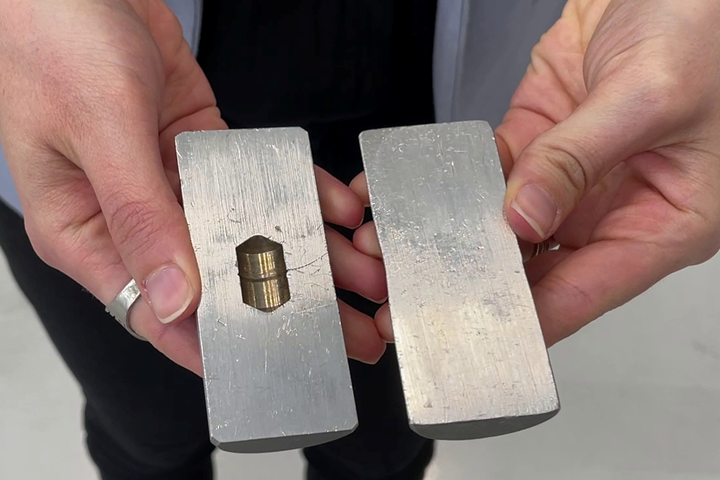
A dramatic illustration of the capabilities of HIPing. While the process is often used to mitigate porosity throughout a part, it can also be applied to close a much larger void like this one. More in the video below. JUMP TO VIDEO
What is hot isostatic pressing (HIP)?
Hot isostatic pressing (also called HIP or HIPing) is a process that consolidates material and closes pores within parts through the application of heat and pressure. It can be applied to many different materials including metals and ceramics. Like furnaces used for more general heat treating of metal parts, HIP furnaces relieve thermal stresses in cast, sintered and additively manufactured parts. However, HIP can also improve part density, ductility, fatigue resistance and other material properties. The HIP process can also include quenching, aging and other postprocessing steps.
How does HIPing work?
The HIP process takes place in a pressure vessel inside a high-temperature furnace. Parts are loaded into the chamber which is then heated, pressurized with an inert gas such as argon, and held at this temperature and pressure for a specified amount of time. The heat and pressure are applied evenly to the part (isotropically), forcing out porosity. The HIPing process can also include pressurized rapid cooling, which functions as a quenching step. HIP cycles can take 8 to 12 hours or longer.
What is the process for hot isostatic pressing of 3D printed parts?
HIPing is now being used for postprocessing of metal 3D printed parts, typically those produced by powder bed-based processes like laser powder bed fusion (LPBF) and binder jetting, though directed energy deposition (DED) parts are sometimes processed this way as well.
Printed parts — either cut off or still on their build plates — are loaded into baskets and transferred to the HIP furnace’s chamber. The chamber is filled with inert gas, heated and pressurized, then held at temperature and pressure for a specified length of time. HIPing “recipes” are customized to the particular material and desired final properties.
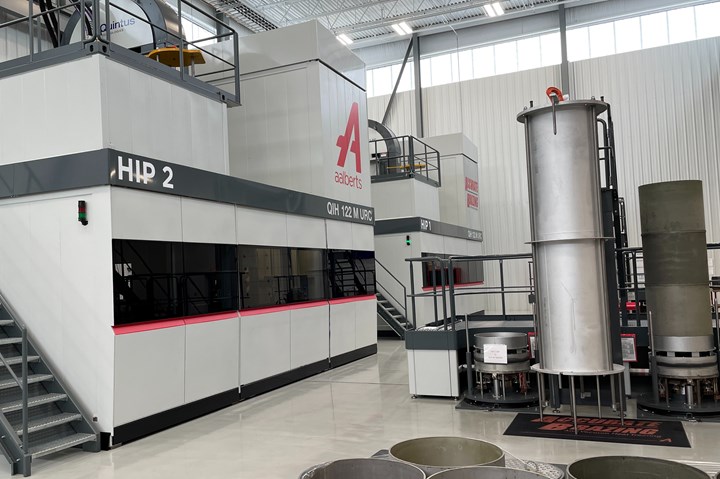
Parts needing HIPing are staged in metal baskets (far right) before being loaded into a pressure vessel and into the HIP furnace (left).
Why HIP 3D printed parts?
Powder-based metal 3D printed parts can suffer from issues like poor layer adhesion, porosity and other defects; HIP offers a way to mitigate these issues by consolidating the material and potentially reducing the severity of any remaining defects. HIPing creates a uniform microstructure in the material, which can improve properties.
Hot isostatic pressing also offers consolidation of steps in the manufacturing process. Many metal 3D printed parts require heat treat after printing to relieve residual thermal stresses; the HIP furnace can accomplish this heat treat alongside quenching, aging and other beneficial processes, saving time in the overall production of metal parts.
An Illustration of Hot Isostatic Pressing
At Aalberts Surface Technologies — Accurate Brazing’s Greenville, South Carolina, facility, the company is establishing HIP services almost entirely dedicated to serving additive manufacturers. To demonstrate the process’s ability to close pores — even large ones — Aalberts uses the sample parts shown in the video above. Each piece began as steel barstock that was cut in two short sections; a hole was machined from the face down into the bar, and then the two halves were welded back together, enclosing the void. Then, one of the samples was put through the HIP process. Both parts were cut in half vertically afterward; the un-HIPed sample shows the void still intact, while in the HIPed part, the hole has completely closed. The part’s slight hourglass shape after hot isostatic pressing was caused by material being pressed inward to fill the void and remove porosity. MORE
Frequently asked questions
What is hot isostatic pressing (HIP)?
Hot isostatic pressing (also called HIP or HIPing) is a process that consolidates material and closes pores within parts through the application of heat and pressure. It can be applied to many different materials including metals and ceramics. Like furnaces used for more general heat treating of metal parts, HIP furnaces relieve thermal stresses in cast, sintered and additively manufactured parts. However, HIP can also improve part density, ductility, fatigue resistance and other material properties. The HIP process can also include quenching, aging and other postprocessing steps.
How does hot isostatic pressing work?
The HIP process takes place in a pressure vessel inside a high-temperature furnace. Parts are loaded into the chamber which is then heated, pressurized with an inert gas such as argon, and held at this temperature and pressure for a specified amount of time. The heat and pressure are applied evenly to the part (isotropically), forcing out porosity. The HIPing process can also include pressurized rapid cooling, which functions as a quenching step. HIP cycles can take 8 to 12 hours or longer.
What is the process for hot isostatic pressing of 3D printed parts?
HIPing is now being used for postprocessing of metal 3D printed parts, typically those produced by powder bed-based processes like laser powder bed fusion (LPBF) and binder jetting, though directed energy deposition (DED) parts are sometimes processed this way as well.
Printed parts — either cut off or still on their build plates — are loaded into baskets and transferred to the HIP furnace’s chamber. The chamber is filled with inert gas, heated and pressurized, then held at temperature and pressure for a specified length of time. HIPing “recipes” are customized to the particular material and desired final properties.
Why HIP 3D printed parts?
Powder-based metal 3D printed parts can suffer from issues like poor layer adhesion, porosity and other defects; HIP offers a way to mitigate these issues by consolidating the material and potentially reducing the severity of any remaining defects. HIPing creates a uniform microstructure in the material, which can improve properties.
Hot isostatic pressing also offers consolidation of steps in the manufacturing process. Many metal 3D printed parts require heat treat after printing to relieve residual thermal stresses; the HIP furnace can accomplish this heat treat alongside quenching, aging and other beneficial processes, saving time in the overall production of metal parts.